What Are Burnouts?
Burnouts are custom shapes cut from flat plate. Burnouts will often have additional stock on the profile of the shape and the thickness in order to be finish-machined to size later. Your specific application will determine what you actually need.
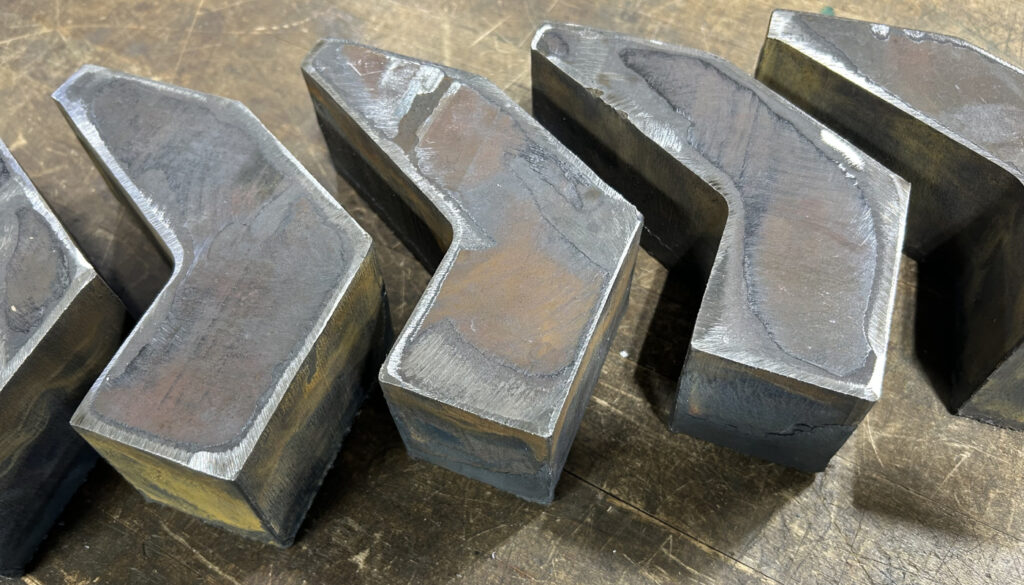
Burnouts, blanks, and cutouts common material types
These can be made from nearly any type of metal or material but are often:
- Hot Rolled Steel (HRS) including A36, 1045, A514, A588 Corten, A606 Corten, and floor plate
- Cold Rolled Steel (CRS) including 1018 and similar
- High strength low alloy (HSLA) including A572
- Wear resistant plate including AR400 and AR500
- Alloy Steel including 4140 Heat Treated
- Stainless Steels including 316 and 304
- Aluminums include 6061 and Cast aluminum tooling plate
Inputs for creating burnouts, blanks, and cutouts
These four inputs are required for creating flame-cut burnouts and other blanks:
- Type of metal
- Thickness of metal
- Shape of burnout
- Quantity
The shape of the burnout can be described in two different ways. The first way is simply by stating as text only. Examples:
- Squares: 2″ THICK x 11-1/2″ SQ
- Rectangles: 2-1/2″ THICK x 9-1/4″ WIDE x 18″ LONG
- Rounds: 16-1/2″ DIA x 3/8″ THICK
- Rings: 15″ O.D. x 9″ I.D. x 1-1/2″ THICK
The second way to express the shape, if not a common geometric shape as stated above, is by providing a CAD drawing of the shape created using CAD software. For any custom profiles, providing a .dwg or .dxf file will often be enough.
How are burnouts, cutouts, and blanks are typically made:
- Plasma cutting (burning)
- Oxy-fuel cutting (heavy plate burning)
- Water Jet cutting (abrasive cutting)
- Laser Cutting
Common tolerances for burnouts / blanks / cutouts:
Tolerancing will vary based on the thickness and size of the burnouts, and the processing method used to create the burnout or blank. Burn tolerances are often +/- 1/16″ for steels up to 2 or 3 inches thick. Water Jet cutting tolerances are typically +/-.01″ for steels, stainless steels, aluminum, copper, and titanium up to a couple inches thick.
Water Jet cutting vs. flame-cut burnouts
The Water Jet cutting and laser cutting equivalent to a burnout is often called a blank or cutout. The same inputs are required to create these as to create a burnout: material type, thickness, shape, and quantity. A major difference with processing via Water Jet cutting is that tighter tolerances can be held and much more complex shapes can be cut. The process of Water Jet cutting does not affect the material properties the same way that burning does because Water Jets do not use heat to cut the material. Instead, they cut using high pressure water and abrasives like garnet.
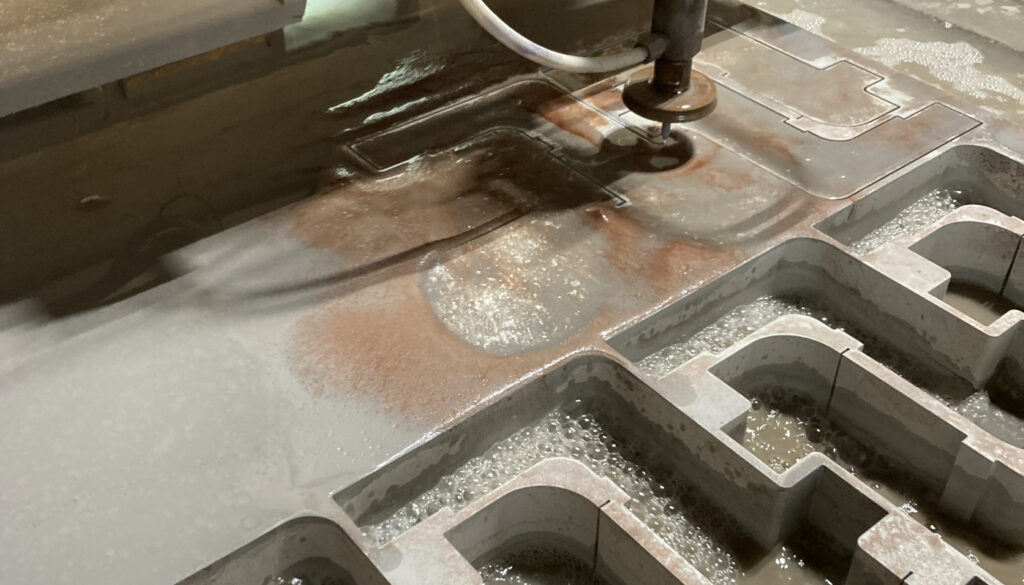
Benefits of Water Jet cutting:
- You can cut ANY type of material including all metals, plastics, glass, composites, etc.
- Improved finish on any cut surfaces
- No heat affected areas so the materials properties do not change
- Tighter tolerances, requiring less post operation machining
Finish Machining for Burnouts and Plate Cutouts
Often, creating the burnout or blank is just the first step to achieving the final product. Secondary machining operations are likely necessary to finish the required features. And even sometimes, a burnout made via plasma or oxy cutting will also require Waterjet cutting for certain features or complex shapes that burning cannot achieve alone.
Most often, a burnout or blank will require drilling, tapping, milling, turning, and/or grinding.
Trim Tool & Machine and similar machine shops can provide these services for customers who need burnouts or blanks finish machined to final specifications. Trim Tool offers Water Jet cutting, CNC machining including CNC milling, CNC turning, grinding and manual machining operations. Whether it’s a one-off part, prototypes, or many pieces, they can provide machining expertise for any sized quantity.
Trim Tool & Machine can supply your burnouts and blanks from all varieties of materials, and process to your finish-machined requirements. They can mill, turn, or grind the top and bottom surfaces of burnouts to achieve a nice machined finish and bring the stock thickness to size.
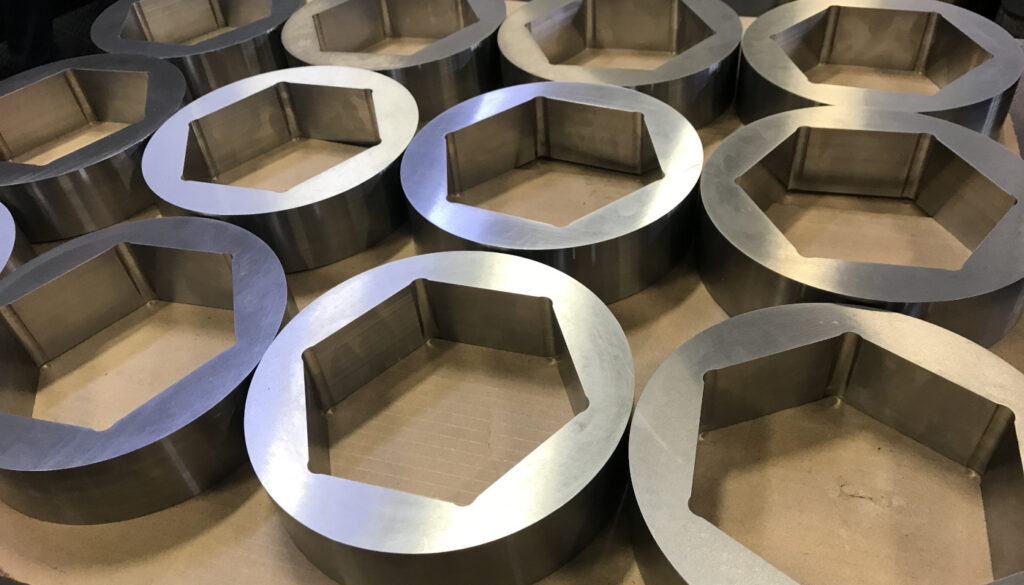
Typical machining operations for plate burnouts and cutouts:
- Milling, drilling, tapping
- Machining slots and pockets
- Turning outside diameter, inside diameter, steps, and features
- Grinding top and bottom, Blanchard grinding
- Squaring or finishing the sides of burnouts
If you need something machined, send Trim Tool & Machine the machining details, drawings, and specifications by emailing sales@trimtoolmachine.com or by using the Quote Form.